Questions...
First published on my blog Jeremy Neideck
This last week, my work has been subjected to the delighted musings, scowling glares and vacant expressions that commonly accompany the art that I produce.
And so, for anyone who is interested in my responses to the common questions I have been asked, I have written down the answers. Not in order to inform or educate, but in order that in future I may be more articulate about the things that I do.
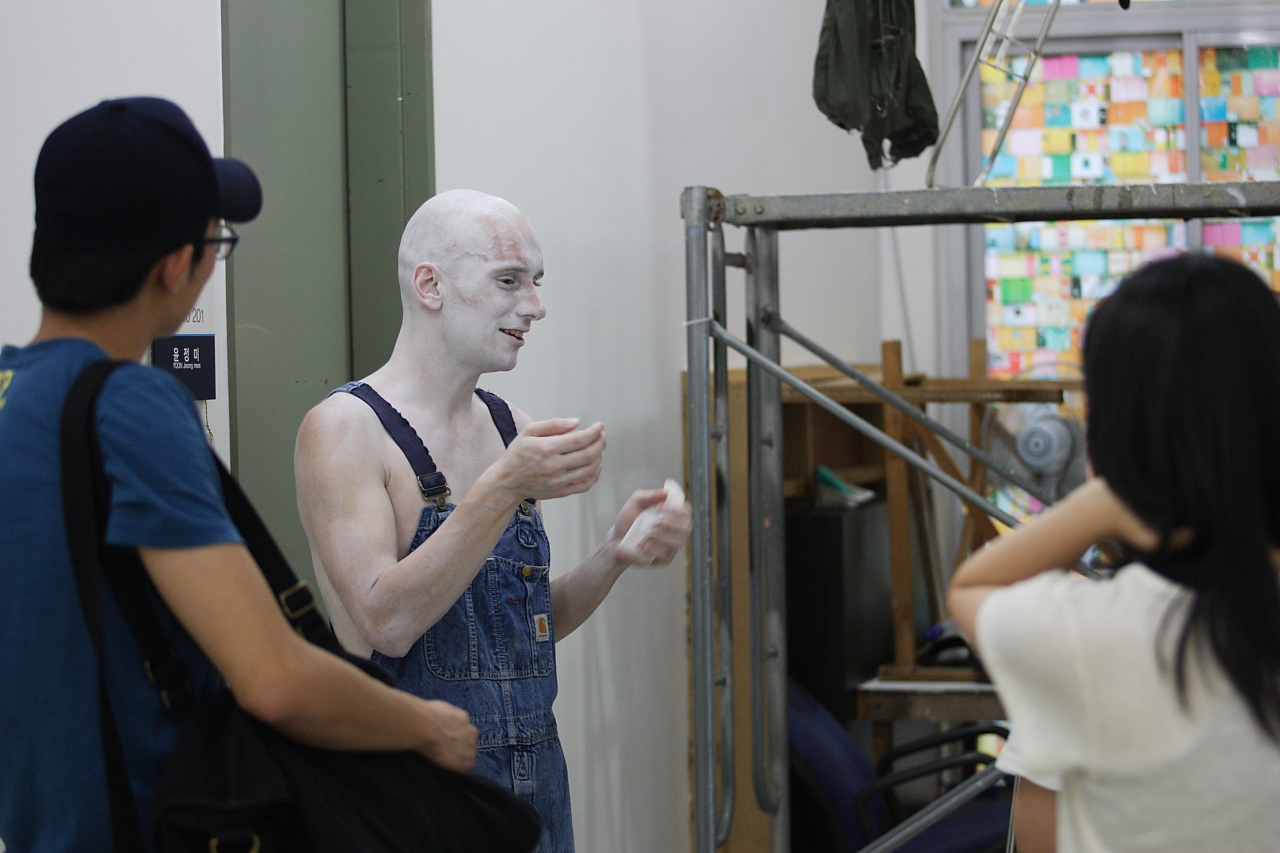
This is the first in a series of posts ‘answering’ those questions. They appear in the order that they are usually asked, as I stand outside my studio, in my overalls, dripping with a delightful mixture of white paint, sweat, glucose and water, or later in the Korean restaurant that I frequent far too often, or as I am put on the spot in a lecture room full of young, aspiring artists (not THAT much younger than I):
Post Everything
What does it mean?
To which my reply is: “What do you think it means?
To me, what is most important is not whether you can decipher my meaning and intention. After all, the creation of meaning is an entirely subjective exercise. Sure, I could encode layers of literal representation and symbolism that are specific to the culture and society in which I create my art, use text and image that clearly lays out my intention so that there can be no misunderstanding as to what I am trying to communicate. But if that was the outcome that I sought, I would probably have pursued a career in documentary film making.
I believe the great potential in art is for it to evoke a truthful response in its audience. For me, this means starting from my own truthful response to a very specific, literal stimulus, often a story I have heard, something I have read, a place that I have visited. I will then break it down into its component parts, ask myself how I feel about it, what meaning I can create from it, finding what symbols and associations I can find within my response to it, and abstracting these into an aesthetic work.
The work I seek to produce is one that incites a visceral response in the audience, either by arresting their view of reality with something unexpected and confronting, or exposing myself to the vulnerability associated with their scrutiny, and in doing so, allowing them to have a sympathetic response to me as a performer, and the work as a whole. Often this manifests itself in ways that the audience cannot rationalise, as a response whose cause they cannot pin down. I have had audience members reluctant to leave the space because they have been overcome by emotion. I have also had dear friends eat dinner with me after a performance, say almost nothing, and days later write to me to say that they were confused by my work, and that it is probably bullshit.
This multitude of readings and responses is the most exciting outcome of any art, and an attestation to its great potential. The most I can hope for is that I can allow the audience to feel, and that later, they will remember this feeling and allow it to influence their life in some way.
Of course, I am not so naive as to think that the cloud on which I live is entirely outside of the realm of rational thought and that I can somehow entirely transcend the semiotic process and speak directly to the souls of my enraptured audience. The human brain is always looking for meaning, no matter how long you try to suspend it in a place of aesthetic arrest. And as an art maker, I am always trying to make sense of my art by using symbols and hooks that are familiar to me and to the environment in which I live. My art means a great deal to me, and however misguided it may seem, I strive for it to come from a place of openness, vulnerability and truth.
But, as any actor knows, you cannot ‘play’ meaning. You cannot ‘play’ symbol, metaphor or agenda. You can only ‘be’ truthful. The context in which I do that is one that I have meticulously crafted. It is contrived and artificial. It is a distorted and abstracted reflection of reality. If the audience sees the work under the assumption I am a ‘serious’ ‘conscious’ artist, then anything that rings true for them whilst experiencing my work is an appropriate response.
But what does it mean?
The reply is still the same: “What do you think it means?
When it becomes clear that I am soliciting a response, rather than posing a hypothetical, a large range of opinions are offered:
“It was about your reflection, dancing with a shadow, seeing something that you don’t expect”
“It reminded me of a Japanese novel about a French exchange student coming to the country for the first time and trying to interact with Japanese society”
“You were drowning in… ah… baby juice”
“I thought it was a statement about Korean nationalism in a global context”
“You got married, and then gave birth”
“You are crazy”
At this point, after divulging their personal views on the work, the patron usually utters the phrase: “that’s right, isn’t it?” insisting that I ratify their interpretation. I never have any reason to argue. I am often surprised at the amount of people pointing out images and meanings in the work that I never intended, but which are connected in some way to my own truth. And even if I don’t agree with their point of view, all I can do is talk about my feeling about the work, and have a healthy discussion as to why these seemingly oppositional readings are present in the same work.
I am encouraged by an interview I recently heard on Radio National with Edward Albee at the Sydney Theatre Company.
“…Nobody expects to be understood or accepted or have one’s work loved at all times. I don’t write plays to be loved… I am convinced that I write plays for people to learn something and be different. All art to be any good, must be useful. Merely decorative is not enough. Art must be useful, it must change our perceptions. That’s the function of art.
...The question that I loath above most other questions as a playwright: “What’s Your Play About”. My answer to that is, depending on the length of the play: “Oh, about two hours”.
No two people see the same play.”